

How to Choose the Right Hookset for Marlin Lures: A Complete Offshore Trolling Guide
MARLIN FISHING • OFFSHORE TROLLING • LURE RIGGING
Choosing the right hookset for your marlin trolling lures can make the difference between a spectacular strike that ends in disappointment and a successful hookup on the fish of a lifetime. Whether you're targeting blue marlin, white marlin, black marlin, or striped marlin, the hook configuration you choose plays a critical role in how effectively your lure performs and how reliably you convert strikes into solid hookups.
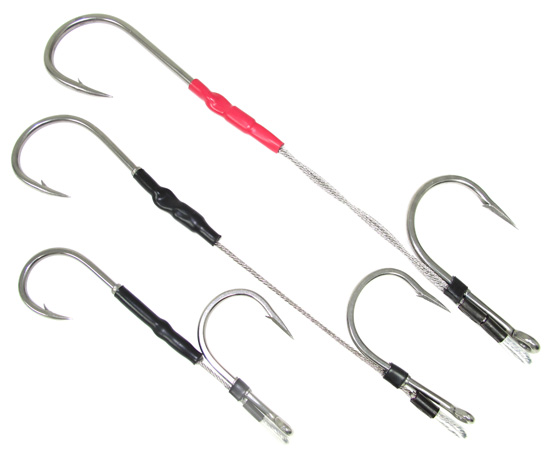
Marlin are among the most powerful and unpredictable gamefish in the ocean. Their explosive strikes, hard bills, aggressive headshakes, and incredible speed put tremendous demands on every component of your tackle. While anglers often spend considerable time selecting lure colors, head shapes, skirt combinations, and trolling positions, the hookset deserves just as much attention.
A properly selected and rigged hookset must accomplish three important things:
-
Allow the trolling lure to swim naturally without interfering with its intended action.
-
Position a strong, sharp hook where it has the best opportunity to penetrate during a strike.
-
Maintain a secure connection throughout a demanding fight without compromising the safety of the crew or the fish.
In this guide, we'll examine single-hook and double-hook rigs, hook sizes, hook styles, materials, positioning, rigging methods, and the factors that should influence your hookset selection.

1. Understanding the Role of a Marlin Lure Hookset
Unlike natural bait, a skirted trolling lure is designed to imitate the movement, silhouette, and commotion of a fleeing baitfish. The lure head and skirt generate the action that attracts a marlin, but the hookset is responsible for turning the strike into a hookup.
The challenge is that marlin don't always attack a lure in the same manner.
A blue marlin may charge from below and engulf the lure in a single explosive strike. Another fish may slash at the lure with its bill, knock it sideways, or repeatedly strike without fully committing. White marlin and striped marlin may be particularly adept at grabbing, slapping, or mouthing a lure without becoming hooked.
These different feeding behaviors help explain why no single hook configuration is perfect for every marlin lure or fishing situation.
An effective hookset should balance several competing requirements:
-
Hook exposure: The hook point and gap must be sufficiently exposed to penetrate during a strike.
-
Lure action: The rig should not cause the lure to spin, track incorrectly, or lose its intended swimming motion.
-
Strength: Hooks must withstand high drag loads, sudden impacts, and prolonged fights.
-
Weight: Excessive hook weight can alter how a lure swims and surfaces.
-
Rig stability: The hook should remain in its intended orientation without excessive movement or tangling.
-
Fish safety: Hook selection and placement should minimize unnecessary injury, particularly when practicing catch-and-release fishing.
The ideal hookset is therefore not necessarily the largest or strongest rig available. It is the one that provides the best combination of lure performance, hooking efficiency, and reliability.
2. Single-Hook vs. Double-Hook Marlin Lure Rigs
One of the first decisions when rigging a marlin lure is whether to use a single-hook or double-hook configuration.
Both have a long history in offshore trolling, and both can be effective when matched to the appropriate lure and fishing conditions.
Single-hook marlin lure rigs

Single-hook rigs have become a popular choice among many experienced offshore crews, particularly when targeting large blue marlin and practicing catch-and-release fishing.
A single-hook rig typically uses one heavy-duty J-style hook positioned near the rear of the lure skirt. The hook may be attached to a cable, wire, or appropriately designed leader-and-connection assembly.
Advantages of single-hook rigs
-
Fewer hooks to become tangled in the leader, skirt, or fish.
-
Reduced risk of a second hook swinging freely during leadering and release.
-
Generally easier and safer to handle alongside the boat.
-
Less rigging weight than comparable two-hook assemblies.
-
Potentially improved lure action, particularly on smaller or more sensitive lures.
-
Simpler inspection and replacement.
Single-hook rigs are particularly attractive for larger marlin lures where one properly positioned hook offers sufficient exposure and penetration potential.
Potential disadvantages
A single hook provides only one point of contact. If a fish strikes the lure without reaching the hook, or if the hook point is poorly oriented, the fish may not become hooked.
Single-hook rigs also demand careful attention to hook placement. A hook buried too deeply inside a large skirt may have limited opportunity to penetrate, while one positioned too far behind the lure can interfere with its swimming action or increase fouling.
Double-hook marlin lure rigs

Double-hook rigs incorporate two hooks in a single assembly, commonly arranged in tandem with the hooks oriented at a fixed angle to each other.
Traditionally, anglers have used double-hook rigs to provide additional hook-point coverage, particularly when targeting billfish that strike aggressively but do not always engulf the lure.
Advantages of double-hook rigs
-
Two hook points may provide additional opportunities for contact during certain strikes.
-
They can be useful in some traditional lure configurations where hook coverage is a priority.
-
A properly built stiff rig can maintain a consistent hook orientation.
Potential disadvantages
-
Additional weight can negatively affect lure action.
-
More hardware creates additional opportunities for fouling.
-
The second hook can increase the danger to anglers and mates when handling a hooked fish.
-
Multiple hook points may cause additional injury.
-
Rigging requires greater attention to spacing, alignment, and mechanical strength.
Double-hook rigs should not automatically be assumed to produce higher hookup rates. Actual performance depends on the lure, target species, strike behavior, rig geometry, and fishing technique.
Which configuration should you choose?
|
Fishing application |
Suggested starting point |
|---|---|
|
Large blue marlin trolling lures |
Heavy-duty single hook |
|
Medium blue marlin lures |
Single hook; evaluate traditional double rigs where appropriate |
|
White marlin trolling lures |
Smaller, lighter single hook |
|
Striped marlin trolling lures |
Single hook matched to lure size |
|
Black marlin trolling lures |
Strong single hook sized for the lure and fish |
|
Catch-and-release marlin fishing |
Single hook, with applicable regulations checked |
For most recreational crews, a well-rigged single hook is an excellent starting point. Double-hook rigs remain an option where legal and appropriate, but their additional complexity and handling risks should be carefully considered.
3. Choosing the Correct Hook Size for Marlin Lures
Hook size is one of the most important factors in building an effective marlin lure hookset.
A hook that is too small may lack the gap needed to engage the fish's jaw or may not have sufficient strength for the drag pressures involved. A hook that is too large can add unnecessary weight, interfere with the lure's action, and make clean penetration more difficult.
Marlin lure hook size chart
The following chart provides general starting points for selecting hooks based on overall skirted lure length.
|
Lure length |
Typical single-hook size |
Common application |
|---|---|---|
|
6–8 inches |
7/0–9/0 |
Small marlin lures, white and striped marlin |
|
8–10 inches |
8/0–10/0 |
Medium marlin lures |
|
10–12 inches |
9/0–11/0 |
Blue marlin trolling |
|
12–14 inches |
10/0–12/0 |
Large blue and black marlin lures |
|
14–16+ inches |
11/0–13/0 |
Extra-large marlin lures |
Why hook gap matters more than the number
A common mistake is selecting a hook based entirely on its advertised size.
A 10/0 hook from one manufacturer may have a substantially different gap, shank length, and wire diameter than a 10/0 from another manufacturer.
The hook gap is the distance between the hook point and the shank. This dimension helps determine whether the hook can engage the fish's jaw effectively.
For example, a thick-shanked 11/0 hook with a relatively narrow gap may be less suitable for a particular lure than a strong 10/0 hook with a wider gap.
When evaluating hook size, consider:
-
The diameter and shape of the lure head.
-
The thickness and fullness of the skirt.
-
The expected size of the marlin.
-
The hook's actual gap and throat depth.
-
The strength and diameter of the hook wire.
-
The amount of weight the hook adds to the lure.
Experienced lure designer Peter Pakula has emphasized the importance of hook geometry, particularly the relationship between the hook's point, its eye, and the fish's jaw.
Should you use oversized hooks for giant blue marlin?
Not necessarily.
Although larger hooks are often stronger, increased size alone does not guarantee better penetration or holding power.
A high-quality forged hook with an appropriate wire diameter and gap may perform better than an oversized hook that is poorly matched to the lure.
Large marlin can exert tremendous leverage against a hook. The ideal choice is a hook that provides adequate structural strength without becoming unnecessarily heavy or difficult to set.
4. Choosing the Best Hook Style


Not all fishing hooks are designed for the same purpose. For conventional marlin trolling lures, the most common choice is a heavy-duty J-style hook.
J-hooks
J-hooks have been used successfully for marlin lure trolling for decades.
They are particularly well suited to artificial trolling lures because their exposed points can penetrate during a fast-moving strike when the fish pulls against the line.
Important features include a strong forged construction, an appropriately sized gap, a sharp point, and sufficient strength to withstand heavy drag.
Straight-point vs. beak-point hooks
A straight-point hook has a point that generally follows the direction of the shank. A beak-point hook has a point that curves inward toward the shank.
Straight-point hooks offer direct point exposure and are commonly used in traditional offshore trolling applications.
Beak-point hooks may offer favorable penetration and holding characteristics in some configurations, particularly when the direction of pull aligns well with the hook point.
Neither design is universally superior. The angle of pull, wire diameter, hook orientation, and lure behavior all affect performance.
Needle-eye vs. ring-eye hooks
Needle-eye hooks feature a narrow eye that can be advantageous in certain cable-based rigs. They are commonly associated with heavy-tackle marlin trolling.
Ring-eye hooks provide a conventional eye that accommodates a range of attachment methods.
The choice should depend on the rigging system rather than eye style alone. The attachment must remain secure, allow the intended movement, and avoid damaging the leader or cable.
Circle hooks
Circle hooks are widely used in billfish fishing, especially with natural baits, because they can promote jaw and corner-of-mouth hookups when used correctly.
However, circle hooks are generally not the preferred choice for conventional high-speed skirted marlin trolling lures. Their hooking mechanism differs from that of J-hooks and typically relies on the hook rotating into position as the line comes tight.
For traditional skirted trolling lures, a purpose-built heavy-duty J-hook remains the standard starting point.
5. Stainless Steel vs. Non-Stainless Hooks
The material and finish of a marlin hook affect its corrosion resistance, maintenance requirements, and potentially its behavior if left in a released fish.
Stainless steel hooks
Stainless steel hooks are popular in offshore trolling because they resist corrosion and can remain serviceable through repeated exposure to saltwater.
They are useful for rigs that may be deployed frequently and stored between fishing trips.
However, stainless steel is not maintenance-free. Hooks should still be washed, dried, and inspected for corrosion, cracks, bending, and point damage.
A major consideration is that stainless steel generally persists longer if a hook must be left in a fish.
Carbon steel and other non-stainless hooks
Non-stainless steel hooks, including carbon steel designs with protective finishes, can offer excellent strength and penetration.
They are also generally more susceptible to corrosion when exposed to saltwater.
For catch-and-release applications, non-stainless hooks are often preferred because they are more likely to corrode if left in a fish. The rate is unpredictable, however, and corrosion should never be treated as a substitute for proper release practices.
The key consideration: Choose a hook with the required strength, suitable geometry, and reliable manufacturing quality. Corrosion resistance alone should not determine your selection.
6. Hook Position: Where Should the Hook Sit in the Lure Skirt?

Hook position can have as much influence on hookup performance as the hook itself.
In many traditional marlin lure rigs, the hook is positioned toward the rear of the skirt, with the bend near the skirt's end and the hook point clearly exposed.
This placement allows the lure to maintain its intended profile while providing a reasonable opportunity for the hook to engage a striking fish.
Positioning the hook too far forward
If the hook is buried deeply inside the skirt, the skirt material may interfere with point exposure.
The hook may also be poorly positioned for fish that strike the rear of the lure without fully engulfing it.
Positioning the hook too far back
Moving the hook farther behind the lure can increase exposure, but excessive extension introduces other problems.
A hook positioned too far back may swing excessively, foul in the skirt or leader, change the lure's tracking, or create unnecessary risk of foul-hooking.
It may also violate tournament or record-fishing rules.
Recommended starting position
For many conventional single-hook marlin lures, start with the hook bend near the trailing edge of the skirt, allowing the point to remain exposed.
Then adjust the hookset length based on the lure's head design, swimming action, and intended rigging method.
A rig that works perfectly in one lure may perform poorly in another, even if both lures have the same overall length.
7. Hook Orientation: Point Up or Point Down?
The orientation of the hook is another subject that generates considerable debate among experienced marlin fishermen.
Many crews prefer the hook point facing upward, while others use point-down configurations on particular lure styles.
Point-up hooksets
A point-up configuration is popular because anglers believe it can improve the likelihood of hooking a fish in the upper jaw or corner of the mouth.
A properly balanced hookset may also naturally ride with the point upward as water flows around the hook.
This is especially common with symmetrical lure heads such as bullets, jets, and certain cupped-face designs.
Point-down hooksets
Some asymmetric or slant-faced lures swim more consistently with the hook point facing downward.
On these lures, hook weight and orientation can affect whether the lure tracks straight or rolls onto its side.
The importance of lure balance
Experienced captains interviewed by Marlin magazine have reported success with different orientations depending on lure geometry. The common theme is that the lure must swim correctly, and the hookset should support that action rather than fight it.
Practical recommendation: Begin with the manufacturer's recommended hook orientation. If no recommendation is available, test a point-up single-hook configuration and observe the lure carefully. Adjust only if its action or tracking suggests a problem.
8. Stiff Rigs vs. Swinging Hooksets
Hookset stiffness determines how freely the hook moves in relation to the lure.
This is an important consideration because marlin strikes can occur from almost any angle.
Stiff hooksets
A stiff rig uses a rigid or semi-rigid connection to keep the hook in a relatively fixed position.
Common construction methods include heavy cable and appropriately applied heat-shrink tubing.
Stiff rigs can help maintain a predetermined hook orientation and reduce uncontrolled movement.
They are frequently used on larger trolling lures where consistent positioning is desirable.
Swinging hooksets
A swinging rig allows the hook to move more freely.
Supporters argue that this freedom allows the hook to align with the direction of pull during a strike, potentially improving penetration in certain situations.
Swinging rigs can also reduce the tendency of a rigid hook assembly to influence lure action.
However, too much movement can create tangling and fouling problems.
Semi-stiff hooksets
A semi-stiff rig offers a compromise between these two approaches.
The connection is controlled enough to help maintain position but retains some movement when pressure is applied.
|
Rig type |
Primary advantage |
Primary tradeoff |
|---|---|---|
|
Stiff |
Consistent hook positioning |
Less freedom to align under load |
|
Swinging |
Greater freedom of movement |
More opportunity for tangling |
|
Semi-stiff |
Balance of positioning and movement |
Requires careful tuning |
There is no universally proven winner. The best configuration depends on the lure's design and the crew's fishing technique.
9. Matching the Hookset to the Marlin Lure Head
Different lure head shapes produce different swimming actions. Because hook weight and position influence the lure's balance, the hookset should be selected with the head design in mind.
Slant-Face Lures
Slant-face lures are designed to dive, track, and surface with an aggressive action. Excessive hook weight or incorrect orientation may cause the lure to roll or swim inconsistently.
Start with a balanced single-hook rig and carefully test its orientation. Some slant-face designs benefit from additional stabilization.
Cupped-Face Chuggers
Cupped-face lures create surface disturbance and a bubble trail. Hook weight and rig stiffness can affect their breathing cycle.
A single-hook rig with adequate exposure is a useful starting point. Check that the hookset does not cause the lure to dive too deeply or lose its surface action.

Bullet-Head Lures
Bullet heads generally run straighter and create less surface disturbance than aggressive chuggers.
They often work well with single-hook rigs, including controlled swinging configurations. Hook placement toward the rear of the skirt is commonly used.
Jet-Head Lures
Jet heads use water flow through the lure head to create bubbles and movement.
Their relatively straight-running action can accommodate several hookset styles, but a heavy or unbalanced rig may still alter performance. Test the complete rig at the intended trolling speed.
10. Building a Reliable Single-Hook Marlin Lure Rig
A quality hookset is only as reliable as its weakest connection.
Even the strongest hook can fail to land a fish if the cable, crimps, leader, or attachment hardware are incorrectly selected or assembled.
Essential rigging components
A conventional cable-based single-hook assembly may include:
-
A heavy-duty forged J-hook.
-
Marine-grade cable or wire of suitable strength.
-
Properly matched crimp sleeves.
-
A purpose-built crimping tool.
-
Protective chafe tubing or heat-shrink tubing where appropriate.
-
A compatible connection to the lure leader.
-
Hook positioning or stabilization components, if required.
Cable strengths of approximately 900 pounds have been used by experienced heavy-tackle blue marlin crews, but this is an example of a particular rigging system rather than a universal requirement. The correct components depend on the fishing application and must be compatible with one another.
Step-by-step rigging process
Step 1: Select the hook. Choose a hook with the appropriate gap, wire strength, and overall dimensions for the lure and intended target species.
Step 2: Determine the hookset length. Place the hook alongside the lure to identify the desired position near the rear of the skirt. Account for the length of the connections and any protective tubing.
Step 3: Prepare the cable. Cut the cable cleanly using a cutter designed for the material. Avoid frayed strands, sharp ends, or unnecessary kinks.
Step 4: Attach the hook. Assemble the hook connection using the specified sleeves, hardware, and crimping procedure for that cable system. Incorrect crimping can severely weaken an otherwise strong rig.
Step 5: Protect vulnerable areas. Use appropriate chafe protection where cable or leader material may rub against metal components. Heat-shrink tubing can also provide controlled stiffness when compatible with the materials.
Step 6: Connect the hookset to the leader. Ensure the connection allows the intended movement while remaining secure under the expected loads.
Step 7: Check alignment. Position the hookset inside the lure and verify that the hook point is exposed and the assembly is centered.
Step 8: Test the completed rig. Inspect the crimps, check for binding or interference, and verify the assembly using the component manufacturers' recommended testing procedures.
Finally, troll the lure at its intended speed and watch its action from the cockpit. A correctly assembled hookset is not necessarily a correctly balanced hookset.
11. How Trolling Speed Affects Hookset Selection
Trolling speed changes the water pressure acting on the lure and hookset.
As speed increases, the hook experiences greater hydrodynamic forces. These forces can affect orientation, stability, and the movement of a swinging rig.
At higher speeds, a poorly balanced hookset may cause the lure to roll, spin, or run incorrectly.
At lower speeds, a different balance may be required to maintain the intended action.
The key is to evaluate the entire system at the speed you actually fish.
A hookset that performs well behind the boat at 7 knots may behave differently at 9 knots, particularly when trolling in rough seas.
When testing a rig, pay attention to whether the lure runs consistently, produces its intended bubble trail, dives and resurfaces correctly, and maintains a stable hook orientation.
Avoid changing several variables simultaneously. If the lure is not running properly, adjust one factor at a time so you can identify what actually improves its performance.
12. IGFA Hookset Regulations and Tournament Considerations
Anglers competing in billfish tournaments or pursuing world records must pay particular attention to hook regulations.
Under the International Game Fish Association's 2026 international angling rules, skirted artificial lures are subject to specific hook arrangement restrictions.
Important requirements include:
-
No more than two single hooks may be used on a skirted artificial lure.
-
On a conventional two-hook lure rig, hook eyes must generally be separated by at least the overall length of the largest hook and no more than 12 inches (30.48 cm), with a specified exception when one hook point passes through the other's eye.
-
A trailing hook may not extend more than one hook length beyond the lure skirt.
-
Hook arrangements must comply with the applicable equipment rules, and record applications require documentation of the hook arrangement.
These are selected provisions, not a substitute for the complete regulations.
Before fishing a tournament, review both the current IGFA regulations and the tournament's specific rules. Some events impose additional restrictions on hook quantity, hook style, or other rigging details.
Official reference: IGFA International Angling Rules — March 2026
13. Common Hookset Mistakes That Cost Anglers Fish
Even experienced marlin fishermen occasionally overlook basic rigging problems.
Here are some of the most common issues to check before deploying a lure.
|
Problem |
Why it matters |
Recommended correction |
|---|---|---|
|
Hook too large |
Adds weight and may affect lure action |
Try a smaller hook with adequate strength and gap |
|
Hook too small |
May lack jaw clearance or strength |
Evaluate a stronger or wider-gap model |
|
Dull hook point |
Can reduce penetration |
Sharpen or replace the hook |
|
Hook buried in skirt |
Limits point exposure |
Reposition the hook |
|
Hookset too long |
May increase fouling or violate rules |
Shorten to an appropriate legal position |
|
Poorly crimped cable |
Creates a potential failure point |
Rebuild using matched components and correct tools |
|
Excessive rig weight |
Can cause poor tracking or diving |
Reduce weight or rebalance |
|
Damaged cable |
May fail under load |
Replace the assembly |
|
Wrong hook orientation |
Can affect swimming action |
Test an alternate orientation |
One of the most preventable mistakes is fishing with a hook that has lost its sharpness.
A hook can become damaged after striking a marlin's bill, contacting the boat, or hitting hard surfaces during handling.
Inspect hook points after every significant strike or hookup, not just at the beginning of the trip.
14. Testing Hookset Performance and Hookup Ratios
One of the best ways to improve your marlin fishing is to track your results.
Rather than assuming a particular hookset is superior, maintain a simple record of how different configurations perform.
Useful information includes lure model, hook manufacturer, hook size, rig style, hook orientation, trolling position, sea conditions, and strike outcome.
You should also distinguish between a fish that merely strikes the lure and one that is positively hooked.
Understanding hookup percentage
For consistent recordkeeping, one useful measurement is:
For example, if a crew records 20 qualifying strikes and successfully hooks 14 fish, its hookup rate is 70%.
Landing percentage is a separate measurement:
A lure may generate many strikes without producing reliable hookups. Another lure may receive fewer strikes but convert them more consistently.
Tracking both figures can help identify whether the issue is lure attraction, hook penetration, or the ability to maintain a hookup.
Keep in mind that small samples can be misleading. A handful of strikes is rarely enough to establish that one rigging method is definitively better than another.
15. Maintaining Your Marlin Lure Hooksets
Marlin hooksets are exposed to saltwater, ultraviolet light, repeated impacts, and substantial mechanical loads.
Regular inspection is essential.
Before every trip, inspect hook points for sharpness and corrosion, examine cable for broken strands or kinks, and check crimped connections for movement or damage.
After a fish is caught or released, inspect the entire rig before putting it back into service.
Pay particular attention to areas concealed beneath heat-shrink tubing or inside the lure skirt.
After fishing, rinse tackle with fresh water and allow it to dry thoroughly before storage.
Replace damaged hooks or questionable connections rather than attempting to get another trip out of compromised tackle.
16. Choosing Hooksets for Different Marlin Species
Although the same general rigging principles apply to all marlin, lure selection and fishing methods vary by species.
Blue marlin
Blue marlin can grow exceptionally large and are capable of tremendous bursts of speed and powerful headshakes.
For larger blue marlin trolling lures, a strong single-hook rig is an excellent starting point. Select the hook based on its actual dimensions and strength rather than simply choosing the largest available size.
White marlin
White marlin are typically targeted with smaller lures and lighter tackle than large blue marlin.
Excessive hook weight can interfere with the action of smaller trolling lures, making a properly sized single-hook rig particularly attractive.
White marlin can also be difficult to hook consistently, so maintaining a sharp point and correct hook position is especially important.
Striped marlin
Striped marlin are frequently targeted with smaller to medium-sized lures.
A lighter single-hook rig may help preserve the lure's action while providing adequate penetration.
Hookset selection should account for the actual lure dimensions and fishing conditions rather than species alone.
Black marlin
Black marlin are powerful fish that demand strong tackle, especially when targeting large specimens.
The hookset should provide adequate strength and a gap suitable for the expected fish.
As with blue marlin, an oversized hook is not automatically the best choice. A balanced, high-quality single-hook rig is often preferable to a heavy assembly that interferes with lure performance.
17. Final Recommendations: What Is the Best Hookset for Marlin Lures?
There is no single hookset that will perform perfectly in every lure, at every trolling speed, and for every species of marlin.
However, for anglers looking for a dependable all-around starting point, the following principles provide a sound foundation.
Start with a high-quality single J-hook.
It offers simplicity, lower handling risk, and proven effectiveness across many marlin trolling applications.
Match the hook to the lure, not just the target fish.
Consider head diameter, skirt length, actual hook gap, wire strength, and overall weight.
Position the hook near the rear of the skirt.
Maintain adequate exposure without excessive trailing length or interference with the lure.
Pay attention to lure balance.
Test hook orientation, stiffness, and weight at your normal trolling speed.
Never compromise on sharpness or rigging quality.
Strong connections, undamaged cable, and a sharp hook point are essential.
Conclusion
Choosing the right hookset for marlin lures requires more than selecting a hook that looks large enough to handle a big fish.
The best results come from understanding how hook size, gap, weight, position, orientation, and rig stiffness work together with the lure's design.
For many offshore anglers, a properly sized single-hook rig provides an excellent balance of hookup potential, lure performance, simplicity, and crew safety. However, successful rigging still requires experimentation, careful observation, and consistent maintenance.
A beautifully designed marlin lure may attract the strike, but the hookset is what gives you the opportunity to turn that strike into a successful catch.
Take the time to rig your lures correctly, inspect your equipment, and evaluate your results. When a blue marlin erupts behind the boat and the reel begins screaming, you'll be glad you paid attention to the details.
Editorial note: Hook sizes and configurations are general starting points, not guaranteed specifications. Always follow manufacturer recommendations and applicable tournament, fishery, and record-fishing rules.