
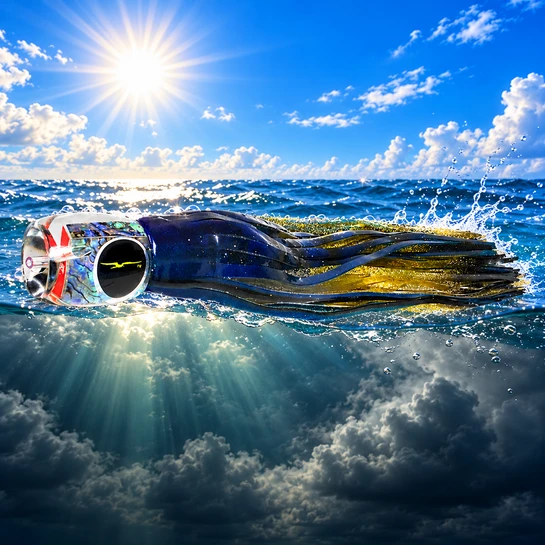
Best Marlin Lure Colors for Sunny vs. Cloudy Days: How to Choose the Right Offshore Trolling Lures (click on lure images that link to product pages)
Choosing the right marlin trolling lure can make a significant difference in offshore fishing success. While lure size, shape, trolling speed, and position in the spread are important, weather conditions and available sunlight can influence how a marlin sees and responds to a lure.
One of the most common questions among offshore anglers is whether different lure colors work better on bright, sunny days compared with overcast or cloudy conditions.
Experienced marlin fishermen often adjust their trolling lure colors based on sunlight, water clarity, sea conditions, and the type of baitfish present.
In this guide, we'll explain which marlin lure colors to consider on sunny and cloudy days, why light conditions matter, and how to build a productive trolling spread for blue marlin, white marlin, and other offshore billfish.
Click Here for our Lure Selection
Why Sunlight Matters When Choosing Marlin Lures
Sunlight affects the underwater appearance of trolling lures.
On bright, sunny days, light penetrates the water and can create strong reflections from metallic lure heads, holographic finishes, and brightly colored skirts.
On cloudy days, reduced direct sunlight can change the contrast between the lure, the water, and the surface.
Marlin often approach trolling lures from below or behind, meaning the lure may be viewed against the brighter surface rather than against dark, deep water.
Because of this, contrast, silhouette, and lure action can be just as important as color.
There is no scientifically established rule that one skirt color always catches more marlin under a particular sky. However, several traditional color combinations provide useful starting points.
Best Marlin Lure Colors for Sunny Days
Bright sunlight and clear blue water are classic offshore trolling conditions.
Many experienced anglers favor natural baitfish colors, translucent skirts, and reflective lure heads under these conditions.

Blue-and-silver combinations imitate the reflective appearance of flying fish, mackerel, and other offshore baitfish. An excellent starting choice for clear water and bright skies.

One of the most established marlin trolling combinations. The darker skirt creates a strong silhouette that can remain visible even in bright conditions.

Often called a dolphin or mahi-mahi color combination. Worth trying when mahi, flying fish, or other colorful surface baitfish are present.

Provides a lighter, high-visibility presentation. A useful alternative when fish aren't responding to natural blue-and-silver patterns.
Why Reflective Lures Can Work on Sunny Days
Many offshore trolling lures feature reflective materials, including:
-
Holographic skirts
-
Metallic inserts
-
Mylar flash
-
Reflective eyes
-
Polished resin heads with internal foil
Under bright sunlight, these materials can produce flashes as the lure surfaces, dives, and rolls.
The flashes may resemble the reflective sides of fleeing baitfish.
However, too much flash isn't always better. A lure's swimming action and position in clean water remain essential.
Click Here for our Lure Selection
Best Marlin Lure Colors for Cloudy and Overcast Days
Cloudy conditions produce softer, more diffuse lighting at the water's surface.
Under these conditions, anglers often experiment with darker, high-contrast skirt combinations or bright colors that are easy to distinguish.

A traditional high-contrast combination. The dark skirt creates a distinct silhouette, while the red adds a secondary color element.

Equally useful on cloudy and sunny days. Its dark profile makes it one of the most versatile colors to keep in a trolling spread.

A bright alternative to darker skirts. Can be worth testing in greenish water, mixed lighting, or when fish are responding to more conspicuous presentations.

Produces a strong silhouette against the surface. Particularly worth considering in low light, early mornings, and heavily overcast conditions.
Why Dark Lures Can Be Effective on Cloudy Days
When a marlin approaches from below, a dark lure may create a well-defined outline against the light filtering through the surface.
This is one reason black, purple, and other dark skirts remain popular among offshore fishermen.
However, darker colors are not exclusively for cloudy days. Black-and-purple lures have caught marlin in virtually every type of daylight condition.
Sunny vs. Cloudy Marlin Lure Color Chart
|
Lure color |
Sunny days |
Cloudy days |
|---|---|---|
|
Blue/Silver |
Excellent starting choice |
Good |
|
Black/Purple |
Excellent |
Excellent |
|
Green/Yellow |
Very good |
Good |
|
Pink/White |
Very good |
Very good |
|
Black/Red |
Very good |
Excellent starting choice |
|
Orange/Yellow |
Good |
Very good |
|
Solid Black |
Very good |
Excellent starting choice |
|
Blue/White |
Excellent starting choice |
Very good |
Water Clarity Is Just as Important as Cloud Cover
Weather isn't the only factor affecting how a marlin sees a trolling lure.
Water clarity can dramatically change the lure's appearance.
Clear Blue Water
In clear offshore water, natural baitfish patterns can be a good starting point.
Consider blue/silver, blue/white, green/yellow, and black/purple.
Green or Slightly Discolored Water
In green water, many anglers experiment with stronger contrast.
Consider black/red, black/purple, orange/yellow, or pink/white.
Dirty or Turbid Water
In heavily discolored water, color differences become less reliable at distance.
Lure vibration, splash, bubble trail, and overall silhouette may become more important.
Rather than relying entirely on a bright skirt, choose a lure head that creates an attractive surface disturbance and swims consistently.
Click Here for our Lure Selection
Choosing Marlin Lure Head Shapes for Different Weather Conditions
Skirt color is only part of the equation.
A marlin trolling lure's head design determines much of its swimming action, bubble trail, and surface disturbance.

Produce aggressive splashing and popping. Useful when a strong surface presentation is desired.

Often produce a diving, swimming, and surfacing action. A versatile option for different sea conditions.

Typically track straighter with less splash. Useful in certain rough-water or higher-speed presentations.

Can create a pronounced dive-and-surface cycle with a substantial bubble trail when properly positioned.
Sunny and Calm Conditions
On bright, calm days, anglers may experiment with smaller heads, subtle swimming action, and natural skirt colors.
Cloudy and Rough Conditions
In rougher water, a larger head or more aggressive lure action may help the lure maintain a visible bubble trail.
However, sea state and wave position matter more to head selection than cloud cover alone.
How to Set Up a Marlin Trolling Spread for Sunny Days
A typical five-lure spread provides opportunities to test different colors and lure actions.
Example sunny-day trolling spread
Conceptual spread, not to scale. Actual positions should be adjusted to the boat's wake and clean-water lanes.The goal is to combine natural colors with at least one dark, high-contrast option.
Don't change every lure to blue and silver simply because the sun is shining.
A mixed spread allows the fish to show you what they prefer.
How to Set Up a Marlin Trolling Spread for Cloudy Days
For cloudy conditions, try a combination such as:
|
Position |
Suggested lure color |
|---|---|
|
Short rigger |
Black/Purple |
|
Long rigger |
Black/Red |
|
Short flat |
Solid Black |
|
Long flat |
Orange/Yellow |
|
Shotgun |
Blue/Silver |
This spread emphasizes contrast while retaining a natural-colored lure.
It is an example rather than a fixed prescription. Adjust the actual positions for lure size, head shape, wake pattern, and the boat's trolling speed.
Does Trolling Direction Relative to the Sun Matter?
Sun angle can influence glare, visibility, and the way lures appear near the surface.
Some crews experiment with trolling direction to improve their ability to see fish approaching the spread.
However, there is no reliable universal rule that trolling toward or away from the sun produces more marlin strikes.
Current edges, bait concentrations, productive water, and sea conditions should usually take priority over sun direction.
Should You Change Lures When Clouds Move In?
Not necessarily.
If a lure is producing strikes, don't change it simply because the weather changes.
Instead, make adjustments when the fish are showing interest without committing, or when the spread has been unproductive.
A practical approach is to change one lure at a time.
This makes it easier to evaluate whether a new color, size, or action is producing better results.
Common Mistakes When Choosing Marlin Lure Colors
Using only one color: A spread with several different colors gives marlin multiple presentations to investigate.
Ignoring lure action: A perfectly colored lure that tumbles, spins, or skips incorrectly is unlikely to perform consistently.
Changing lures too frequently: Constantly changing the spread makes it difficult to identify productive patterns.
Ignoring local baitfish: Matching the size and general appearance of local forage can be more important than following a color rule.
Using the wrong lure in the wrong wake position: Some heads perform better in clean water, while others are designed to work effectively in more turbulent positions.
Overlooking terminal tackle: Properly rigged hooks, leaders, chafe protection, and lure connections are essential regardless of skirt color.
Frequently Asked Questions
What is the best marlin lure color for sunny days?
Blue/silver and blue/white are excellent starting points in clear water, but black/purple is also a proven choice under bright skies.
What is the best marlin lure color for cloudy days?
Black/purple, black/red, and solid black are popular high-contrast choices. Brighter colors such as pink/white and orange/yellow are also worth testing.
Is black and purple a good marlin lure color?
Yes. Black/purple is one of the most versatile and traditionally successful offshore trolling combinations and can be fished in both sunny and cloudy conditions.
Do marlin prefer bright or dark lures?
There is no universal preference. The most productive presentation depends on water conditions, baitfish, lure action, and the behavior of the fish.
Does lure color matter more than lure size?
Often, lure size, swimming action, and position in the trolling spread are more useful adjustments to make first. Color is another variable to test once the lure is performing correctly.
Final Thoughts: Choosing the Best Marlin Lures for the Conditions
When selecting marlin trolling lures for sunny versus cloudy days, start with a few practical principles.
On sunny days, natural colors such as blue/silver, blue/white, and green/yellow are excellent choices, especially in clear blue water. Reflective skirts and lure heads can add flash to the presentation.
On cloudy days, darker colors such as black/purple, black/red, and solid black provide strong silhouettes. Bright colors can also be effective when you want to test a contrasting presentation.
Most importantly, don't overlook lure action, water clarity, sea conditions, and baitfish activity.
The best offshore trolling spread usually includes several complementary lure colors and head styles rather than five identical lures.
The most effective marlin lure isn't necessarily the brightest or darkest one. It's the lure that swims properly, creates the right presentation, and consistently draws strikes under the conditions you're fishing.
For anglers building an offshore trolling spread, carrying a selection of natural, dark, and bright skirt combinations provides the flexibility to adapt as weather and water conditions change throughout the day.
